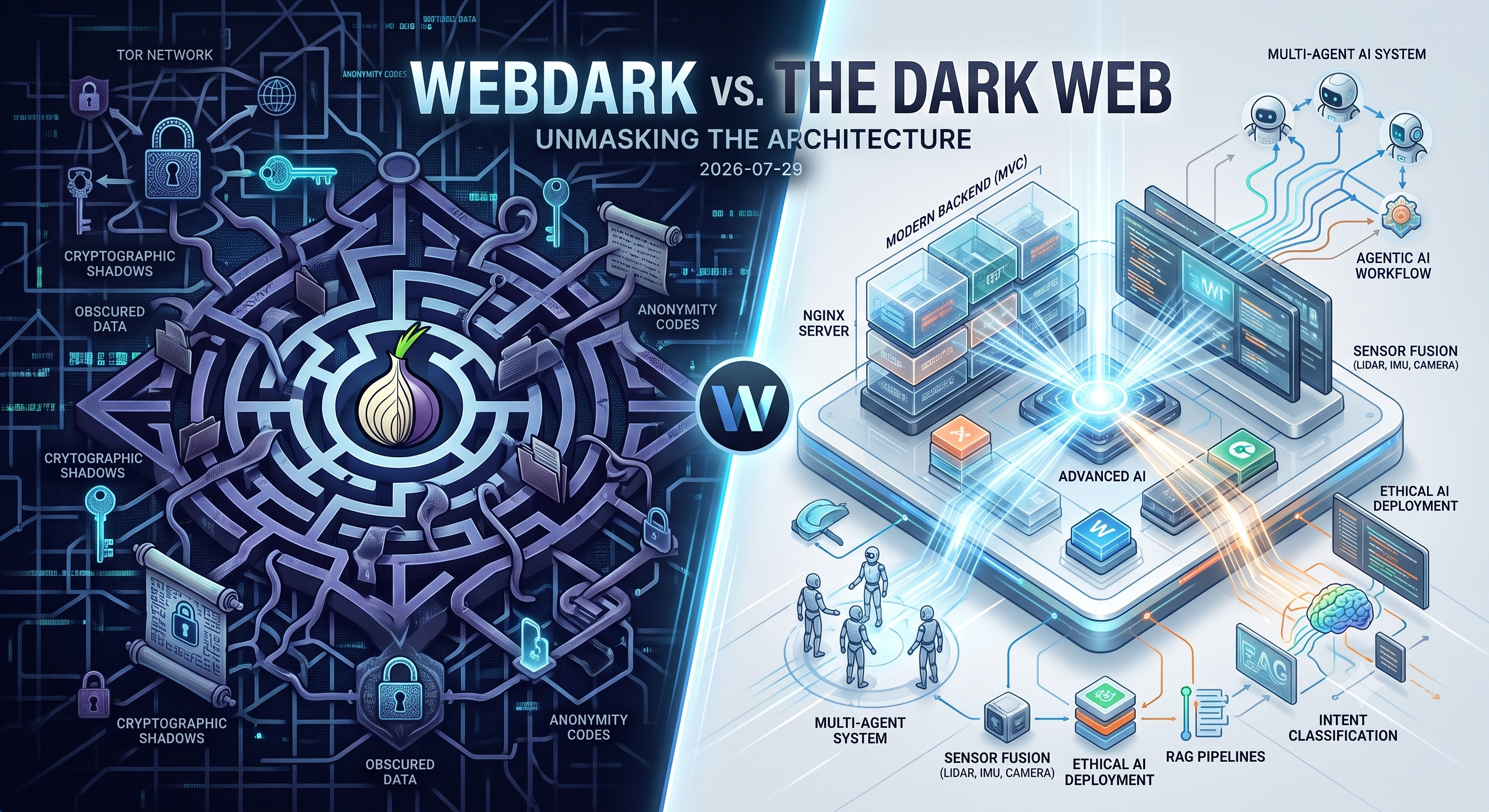
WebDark vs. The Dark Web: Unmasking the Architecture and the Naming Confusion
If you arrived here by searching for the "Dark Web," you might be looking for Tor Browser downloads, cybersecurity guides, or explanations of hidden overlay networks.
You are in the right place to get those answers—but you have also stumbled onto something much more forward-thinking.
There is a distinct, architectural difference between the Dark Web and WebDark. One relies on cryptographic shadows to obfuscate data; the other is a high-performance platform engineered to illuminate the complexities of modern software architecture, Artificial Intelligence, and real-time engineering solutions.
Before you click away, let’s break down exactly how the Dark Web functions under the hood, and why WebDark is the exact opposite.
The Dark Web: An Architectural Reality
To understand the Dark Web, we have to look at the internet as a stratified architecture.
- The Surface Web: This is the indexed internet. If Google, Bing, or DuckDuckGo can crawl a page's HTML and list it in search results, it lives here.
- The Deep Web: This is simply unindexed content protected by authentication gateways. Your online banking dashboard, private database schemas, and academic thesis drafts all live on the Deep Web. It makes up the vast majority of the internet.
- The Dark Web: This is a small, deliberately hidden subset of the Deep Web. It operates on overlay networks—networks that run on top of the standard internet but require specific software, configurations, or authorization to access.
How Tor and Onion Routing Work
The most famous overlay network is the Tor (The Onion Router) network. On the standard web, your browser connects directly (or via a standard reverse proxy) to a server. Your IP address is visible, and the routing is straightforward.
On the Dark Web, traffic is heavily encrypted and bounced through a random sequence of decentralized nodes (relays) scattered across the globe.
- Each node only knows the IP address of the node immediately before it and the node immediately after it.
- Layers of encryption are peeled away at each hop (like an onion), ensuring that no single server ever knows both the origin of the request and its final destination.
While this cryptographic architecture was designed for secure, anonymous communication, it has become synonymous with unregulated, and often illicit, activity. It is a space built entirely on obfuscation.
Enter WebDark: Illuminating the Stack
If the Dark Web is about hiding the infrastructure, WebDark is about breaking it wide open.
WebDark is not an overlay network; it is a custom-built, highly decoupled MVC platform running on a finely tuned Nginx server. We chose the name not to blend into the shadows, but because we tackle the complex, often "in-the-dark" bottlenecks of modern software engineering and bring them into the light.
Instead of hiding data, WebDark is dedicated to providing cutting-edge, transparent insights into the rapidly evolving tech landscape.
What We Actually Build Here
Once you understand how packets are routed on the Dark Web, the next logical step for any engineer or tech enthusiast is understanding how to build systems that scale, think, and adapt. That is the mission of WebDark.
Here is what you will actually find on this platform:
- Advanced AI & Agentic Workflows: We move beyond basic ChatGPT prompts. We deconstruct Multi-Agent Systems, Retrieval-Augmented Generation (RAG) pipelines, and how autonomous AI agents are being integrated into production environments for intent classification and automated workflows.
- Modern Backend Architectures: We dissect real-world performance metrics, database normalization, and architectural bottlenecks in environments utilizing Java, Spring Boot, Python, and custom PHP infrastructures.
- Sensor Fusion & The IoT: Deep dives into how multi-modal sensor fusion integrates LiDAR, IMU, and camera data for real-time, autonomous systems.
- The Ethical Deployment of Tech: Technology is a tool. We critically examine the modern digital footprint, bridging the gap between industry practices and academic research, and advocating for the ethical use of machine learning models to solve daily, real-world problems.
- Industry Pulse: Real-time updates on next-generation data centers, robotics expos, and the shifting paradigms of global tech stacks.
The Verdict: Shadows vs. Light
The Dark Web serves a specific, highly anonymized purpose through complex cryptographic routing. But if you are an engineer, a data scientist, a student, or simply a tech enthusiast looking to understand the systems running our world, the shadows won't help you build a better architecture.
You need high-performance, aesthetically driven, and deeply technical content.
Don't bounce back to the search results just yet. Stick around. Dive into our latest insights on Agentic AI, explore our breakdown of scalable database schemas, or read up on the latest daily-life tech hacks.
Welcome to WebDark
Discussion (0)
Please log in or register to leave a comment.