Domain-Adaptive Hybrid Fusion: A Novel Approach to Faithful Explainability in Transformers
As large language models and transformer architectures continue to dominate Natural Language Processing (NLP), their internal workings remain notoriously opaque. This "black-box" nature is a significant hurdle, particularly in domains where trust, safety, and transparency are paramount. While several Explainable AI (XAI) methods exist to demystify these models, they often suffer from instability, high computational costs, or a lack of faithfulness to the model's actual reasoning.
In our recent research, we set out to rigorously benchmark existing XAI techniques across multiple transformer models and NLP domains. More importantly, we proposed a novel Domain-Adaptive Hybrid Attribution Fusion method designed to bridge the gaps left by standalone explainability algorithms.
Here is a deep dive into our methodology, findings, and the proposed hybrid approach.
The Challenge: Existing XAI Methods Fall Short
Explainability in NLP generally falls into two camps:
- Gradient/Attention-based Methods: Techniques like Integrated Gradients (IG) and Attention Rollout compute token importance efficiently using model weights and gradients. However, they can be highly unstable and sensitive to minor input perturbations.
- Perturbation-based Methods: Techniques like SHAP, LIME, and Leave-One-Out (MICE) measure how the model's output changes when inputs are masked or altered. While often more intuitive, they require hundreds of forward passes, making them incredibly slow and computationally expensive.
Relying on a single metric often results in "Faithfulness Gaps"—cases where an XAI method confidently highlights a set of tokens, but removing those tokens barely changes the model's prediction.
The Research Pipeline: A Cross-Domain Benchmark
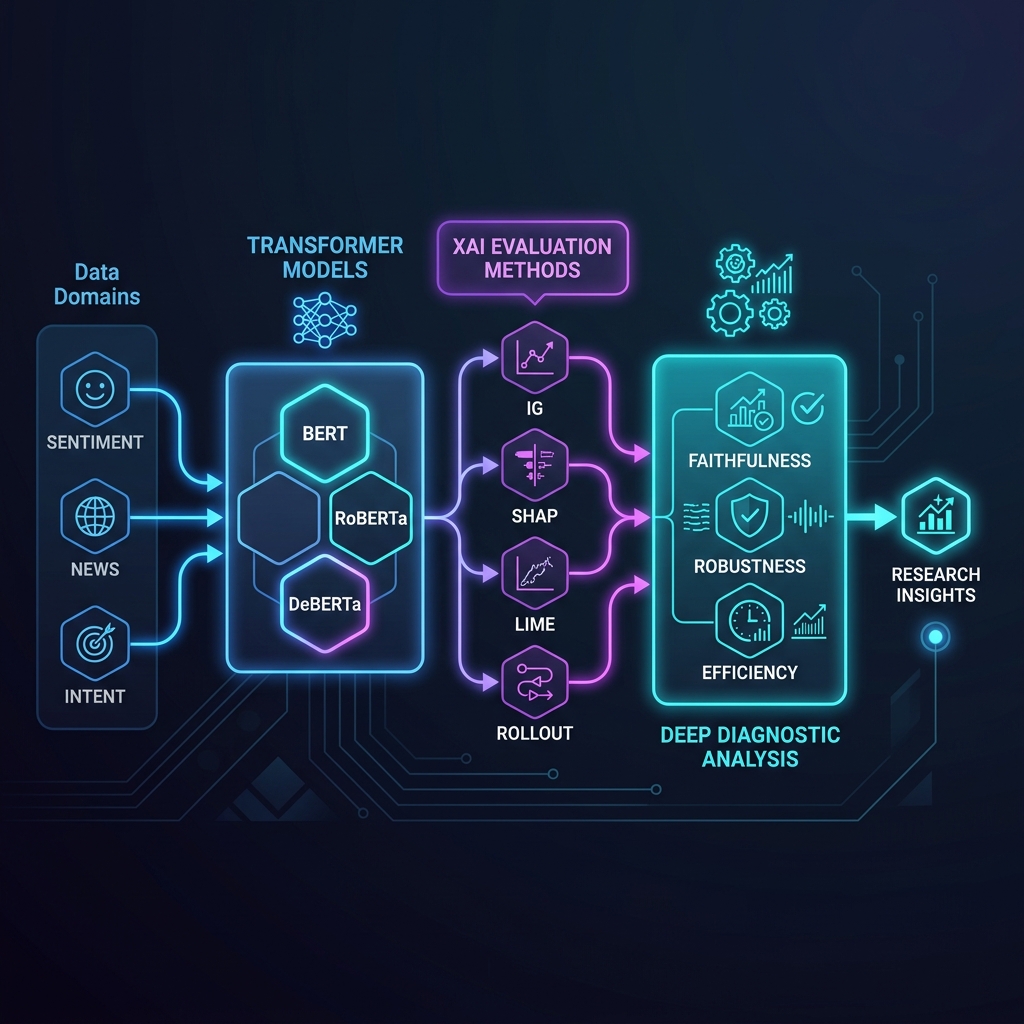
To systematically evaluate these shortcomings, we built an end-to-end research pipeline capable of benchmarking XAI methods across different datasets and architectures.
Domains Evaluated:
We selected three diverse text classification domains to ensure robust evaluation:
- SST-2: Sentiment Analysis (Binary classification)
- AG-News: Topic Classification (4-class categorization)
- Intent: Snips Built-in Intents (10-class intent recognition)
Models & Methods:
We evaluated baseline transformer models (BERT) alongside modern State-of-the-Art (SOTA) variants like RoBERTa-large and DeBERTa-v3. We tested five established XAI methods:
- Integrated Gradients (IG)
- Attention Rollout
- SHAP
- LIME
- MICE (A custom perturbation approach)
Deep Diagnostic Analysis:
Our evaluation wasn't limited to subjective visual checks. We quantified performance using rigorous statistical metrics:
- Faithfulness (Comprehensiveness & Sufficiency): We measured how much the model's confidence dropped when the "most important" tokens were removed, and how well the model performed when only the important tokens were kept.
- Robustness (Stability): We calculated the attribution instability between gradient and perturbation methods.
- Causal Pathways: We ran Pearson correlation tests to understand if linguistic features, like text length, directly impacted explanation faithfulness.
- Efficiency Profiling: We tracked execution time and peak VRAM usage to assess real-world viability.
Proposing Domain-Adaptive Hybrid Attribution Fusion
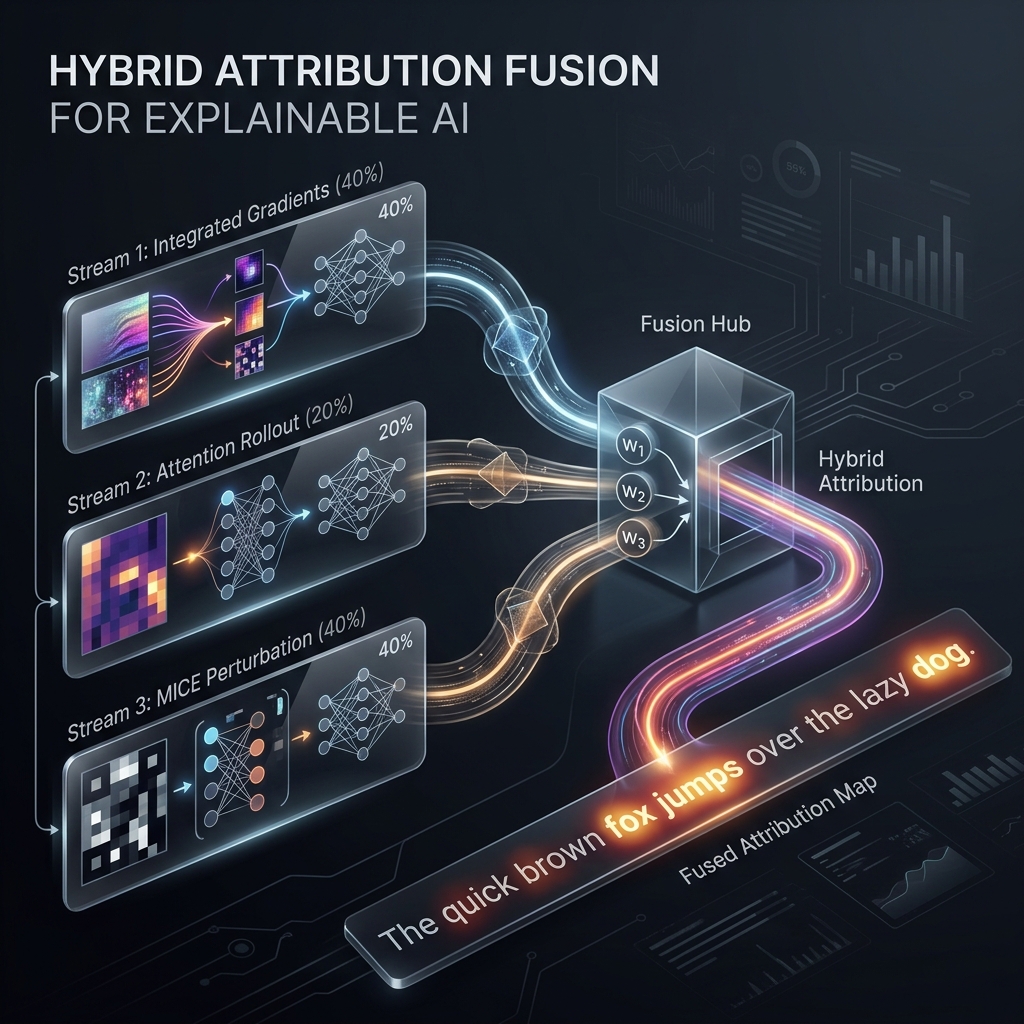
Recognizing the trade-offs between speed, stability, and faithfulness, we proposed a Domain-Adaptive Hybrid Attribution Fusion.
Instead of relying on one technique, our hybrid method leverages a weighted fusion of three distinct approaches:
- 40% Integrated Gradients (IG): To capture fine-grained, gradient-level token importance.
- 20% Attention Rollout: To incorporate the model's internal attention routing and global context.
- 40% MICE (Perturbation): To ensure causal faithfulness by physically simulating token removal.
By normalizing and fusing these signals, the hybrid approach inherently smooths out the noise found in pure gradient methods, while avoiding the massive computational overhead of running full SHAP or LIME explainers. It provides a balanced, robust, and highly faithful attribution map that adapts well across different textual domains.
Key Findings and Takeaways
Our benchmarking suite revealed several critical insights about the current state of XAI in NLP:
1. The Speed vs. Faithfulness Trade-off
Unsurprisingly, perturbation methods are slow. In our AG-News benchmark, SHAP took over 3.1 seconds per sample, compared to just 0.19 seconds for Integrated Gradients and a lightning-fast 0.03 seconds for Attention Rollout. However, Rollout often sacrifices granular faithfulness for speed. Our Hybrid fusion strikes a necessary middle ground.
2. Modern Models Don't Automatically Yield Better Explanations
When comparing BERT against RoBERTa-large and DeBERTa-v3, we found that scaling up the architecture does not linearly improve explainability. In fact, DeBERTa-v3 showed highly variable IG Comprehensiveness scores across domains. This indicates that complex routing mechanisms (like DeBERTa's disentangled attention) can actually obfuscate gradient-based explainability, leading to Faithfulness Gaps.
3. VRAM Efficiency Matters
For edge deployments or large-scale inference, XAI overhead is a real concern. LIME and IG maintained relatively low memory footprints (around 550MB - 1GB depending on the domain), making them far more practical than memory-intensive perturbation suites for real-time analysis.
Conclusion
As NLP models grow increasingly complex, the tools we use to understand them must evolve simultaneously. Our cross-domain evaluation highlights that no single existing XAI method is a silver bullet.
The proposed Domain-Adaptive Hybrid Fusion demonstrates that by intelligently combining the strengths of gradients, internal attention, and causal perturbation, we can achieve more faithful, stable, and practical explanations. Moving forward, the focus of XAI research must shift from singular algorithmic tweaks to robust, hybrid systems capable of explaining the next generation of transformer models.
This article is based on the research project: "Benchmarking Explainability Methods for Transformer-Based Text Classification."
Discussion (0)
Please log in or register to leave a comment.