Quantum Natural Language Processing (QNLP): How Quantum Physics is Rewriting AI
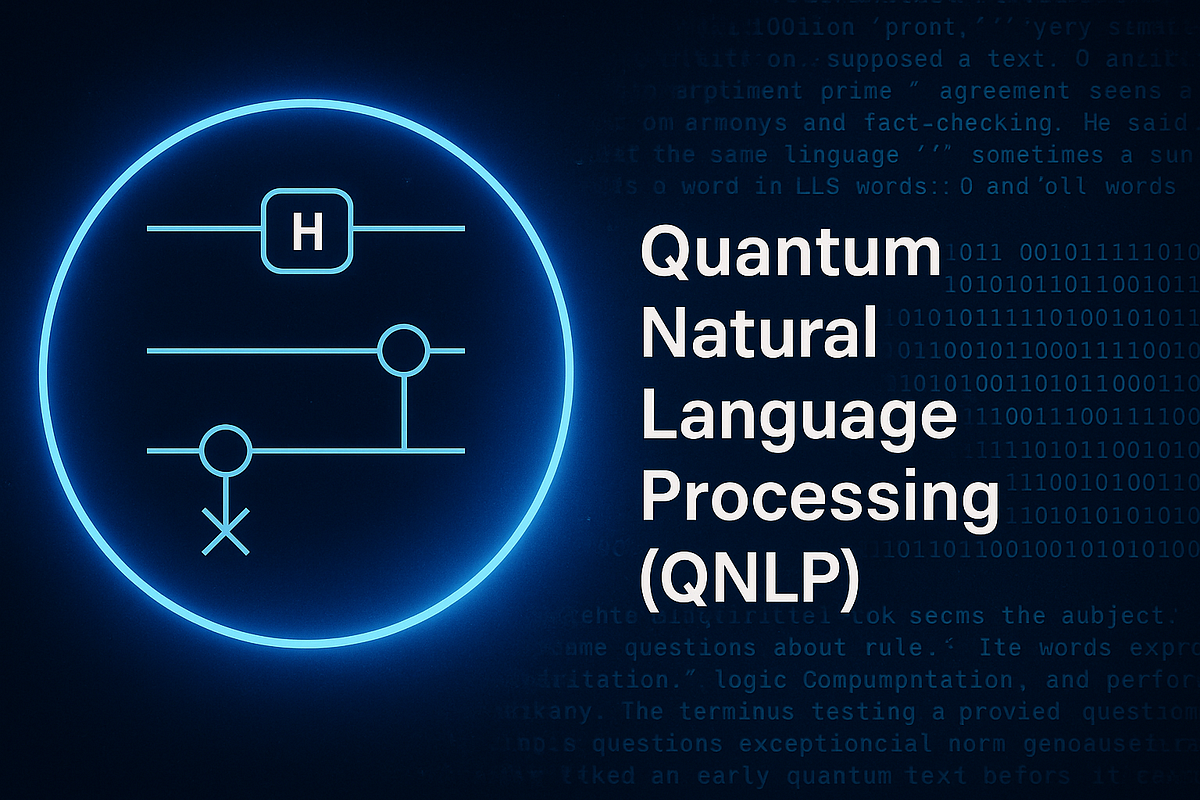
Quantum Natural Language Processing (QNLP) is a groundbreaking field that merges the mathematics of quantum mechanics with the rules of human language.
Modern AI models (like ChatGPT) predict words by turning text into massive lists of numbers and calculating statistical probabilities. QNLP takes a completely different approach: it treats human language as "quantum native." In QNLP, a sentence is not just a string of characters, but an interacting, entangled physical system where meaning changes based on structural context.
Here is a complete breakdown of how QNLP works, what it can do, and why it is the future of advanced artificial intelligence.
Core Theoretical Frameworks
QNLP relies on mapping grammatical rules directly into physical quantum circuits. It is built on three core concepts:
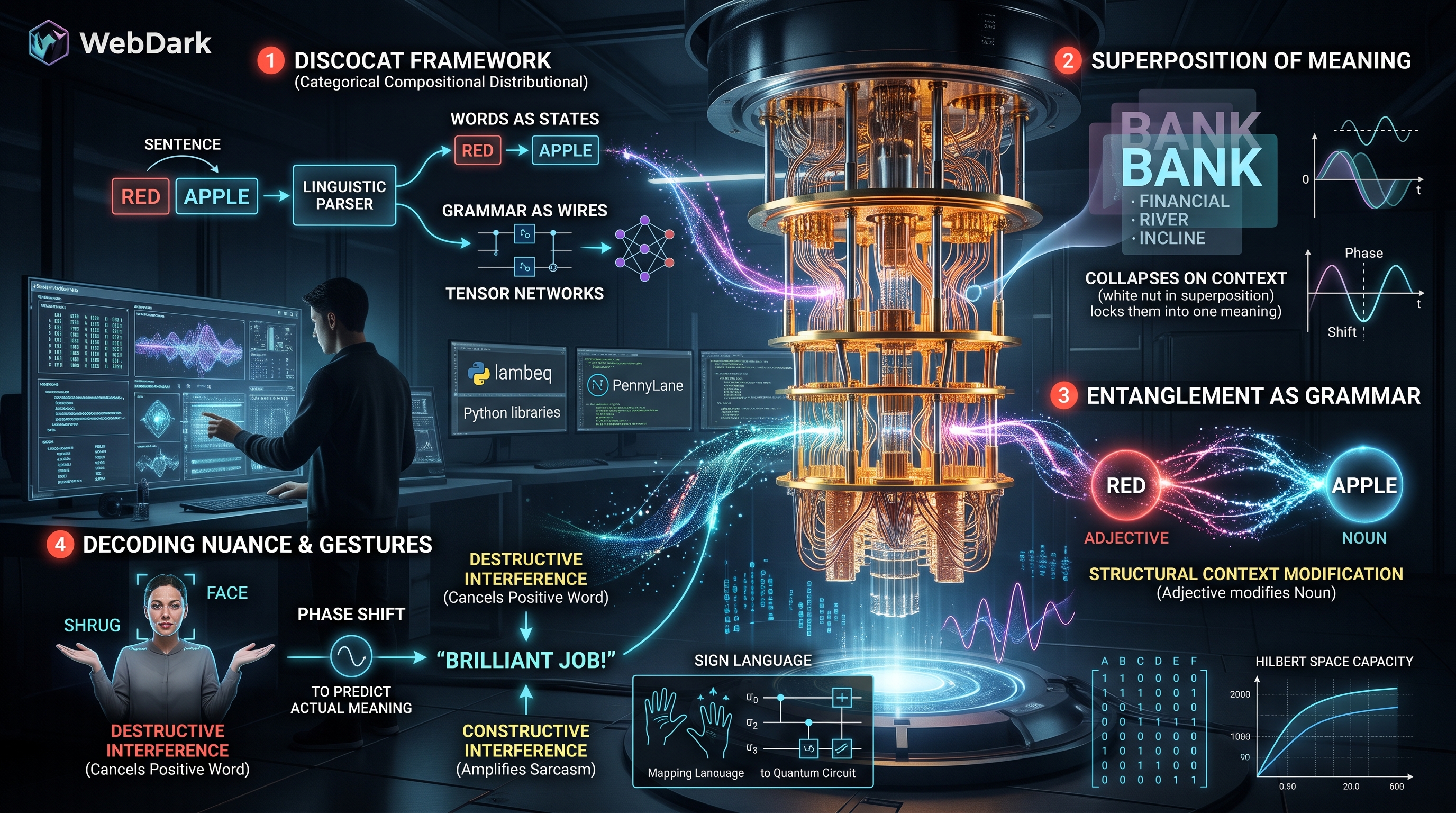
- The DisCoCat Framework: This stands for Categorical Compositional Distributional models. It combines linguistic grammar rules with the tensor networks used in quantum physics. Words become quantum states, and grammatical rules act as the wires connecting them.
- Superposition of Meaning: In classical AI, a word like "bank" has a fixed numerical definition. In QNLP, words exist in a quantum superposition—meaning they hold multiple definitions simultaneously until the surrounding context of the sentence locks them into a single meaning.
- Entanglement as Grammar: When an adjective modifies a noun (like "red apple"), QNLP links them using quantum entanglement. The adjective physically modifies the overall state of the sentence, capturing true structural context.
Prominent Paradigms and Algorithms
Researchers are already running QNLP algorithms on today's Noisy Intermediate-Scale Quantum (NISQ) computers using hybrid classical-quantum pipelines:
- Variational QNLP (VQ-QNLP): Replaces classical neural network weights with trainable quantum gates. Early tests achieved 82.5% accuracy on news classification while using far fewer parameters than classical models.
- Quantum Kernel NLP: Embeds full sentences into highly expressive quantum states for classification. An IBM experiment hit 86.7% accuracy on headline similarity, outperforming classical BERT models.
- DisCoCat Tensor Circuits: Maps syntax directly to physical hardware, reaching 84.2% accuracy in testing Twitter sentiment.
Advantages vs. Bottlenecks
While QNLP offers massive structural benefits, it is currently held back by early-stage hardware limitations.
The Advantages
- Extreme Parameter Efficiency: QNLP can achieve accuracy similar to classical deep learning while using up to 40% fewer parameters, drastically reducing memory needs.
- Small Dataset Optimization: Because quantum math naturally mirrors grammatical structure, QNLP systems can learn complex patterns from tiny datasets rather than needing to read the entire internet.
- True Interdependence: Instead of using complex attention mechanisms to remember the beginning of a paragraph, QNLP uses structural entanglement to inherently understand long-range context.
The Bottlenecks
- The Length Limit: Due to current circuit complexity, QNLP can usually only process short sentences (often capped under 10 words). Attempting long paragraphs causes an exponential explosion in circuit size.
- Hardware Noise: Today’s NISQ quantum computers suffer from "gate noise," which easily disrupts the fragile quantum states of the words.
- The LLM Standard: Classical Large Language Models are advancing rapidly with massive zero-shot reasoning capabilities, making it commercially difficult for QNLP to catch up in generic chat tasks.
The "Live" QNLP Experience Today
There is no "Quantum ChatGPT" you can talk to on a website today. Because of hardware constraints, interactive real-time chat is currently impossible. Instead, QNLP exists as open-source software pipelines run by developers:
- Quantinuum’s lambeq: The foundational Python toolkit for QNLP. It features a neural syntactic parser ("Bobcat") that turns text into grammar diagrams, and a circuit generator that converts those diagrams into runnable quantum circuits.
- PennyLane Integration: Xanadu’s PennyLane platform offers interactive blueprints to build hybrid pipelines, using standard PyTorch to optimize parameters while running the circuits on quantum simulators.
How QNLP Differs from Modern AI
- Interface: LLMs use instant web APIs. QNLP uses local Python frameworks.
- Math: LLMs use self-attention and dense vectors. QNLP uses category theory and tensor networks.
- Scaling: LLMs scale through brute-force data ingestion. QNLP scales through algorithmic efficiency.
Decoding Human Nuance: Sarcasm, Tone, and Culture
Classical AI struggles with sarcasm and idioms because the literal words contradict the intended meaning. QNLP excels here by treating text as a physical system reacting to an environment.
- Predicting the Next Word: Instead of keeping a list of past words, QNLP evolves a single, entangled state vector holding the entire history of the conversation. When predicting the next word, it applies a gate operation, forcing the "wavefunction" of possible words to collapse into a single choice.
- Decoding Sarcasm via Phase Shifts: If you say, "Brilliant job!" (positive words) but use a sarcastic tone (negative intent), QNLP applies a quantum Phase Shift. This causes the positive literal meaning to cancel itself out (destructive interference) and amplifies the hidden negative intent (constructive interference).
- Cultural Values as Background Fields: Cultural norms (like the number "4" being unlucky in Asia) act as a background "vacuum state" in the circuit. Processing a sentence through an East Asian cultural matrix will naturally route the meaning differently than a Western matrix.
The Vocabulary Mechanism
QNLP completely reinvents the dictionary. Instead of storing vocabulary as massive lists of numbers (which eats up massive VRAM), QNLP turns a word’s ID into a physical quantum state (an ansatz).
Because quantum computers use "Hilbert Space," their capacity to hold information grows exponentially with every qubit. Furthermore, vocabulary behaves like chemistry: words are fluid, open states that only lock into a rigid definition when they "bond" with other words in the sentence.
Quantum Machine Translation and Sign Language
Instead of swapping English words for Spanish words, QNLP translates by mapping the underlying geometry of the meaning.
- The Language-Agnostic Core: A sentence is broken down, turned into a quantum circuit, and projected into a "Universal Semantic Space." In this space, the meaning exists independently of any human tongue. A second circuit then unrolls that meaning into the target language.
- Idioms as Composite Particles: Phrases like "kick the bucket" are entangled into a single, non-local quantum state meaning "death." The system simply finds the cultural equivalent in the target language that matches that exact quantum geometry.
- Revolutionizing Sign Language: Sign languages are spatial and continuous, making them hard for classical AI to translate. QNLP can encode hand shapes, spatial coordinates, and facial expressions into a single entangled circuit. By anchoring an invisible point in the air to a quantum state, the system perfectly tracks long-distance spatial references.
Multimodal Gestures
In QNLP, combining text with a visual gesture (like an eye-roll or a shrug) is seamless. A gesture acts as a physical switch (a quantum gate) placed directly on the text circuit. A shrug can instantly flip the meaning of a sentence, while a pointing finger entangles a word like "that" directly to the physical coordinates of an object in the room.
Beyond Language: Non-Linguistic Uses
Because QNLP is essentially a framework for processing structural syntax, it is being applied far beyond human conversation:
- Bioinformatics (The Language of Life): Treating DNA and protein-folding rules as "grammar" to discover molecular combinations and accelerate drug discovery.
- Quantum Chemistry: Converting chemical formulas into syntax strings to simulate complex reactions.
- Smart Contracts & Cybersecurity: Analyzing highly rigid legal documents and programming code to instantly detect loopholes or vulnerabilities with mathematical certainty.
The Future: A Hybrid Architecture
QNLP will not replace traditional LLMs for writing basic emails. Instead, the future is hybrid:
- Generative LLM (The Interface): Classical AI will handle the chatty, conversational interface.
- QNLP Module (The Logic Core): Highly complex, structurally ambiguous tasks will be routed to a quantum co-processor.
- Agentic Orchestration: The quantum system will quickly simulate thousands of execution paths at once, acting as the ultimate decision-maker for autonomous agents.
Because routing data to real quantum hardware is expensive, enterprise QNLP will initially be highly exclusive, limited to defense sectors, pharmaceuticals, and global finance.
The History and Evolution of QNLP
The path to QNLP has moved rapidly from theoretical physics to live software:
- Phase 1: Theoretical Foundation (2010–2019): Coecke, Sadrzadeh, and Grefenstette introduced the DisCoCat model in 2010, proving category theory could unite grammar and quantum mechanics. By 2016, researchers mapped these diagrams to physical logic gates.
- Phase 2: First Implementations (2020–2022): The first full-stack NISQ pipeline was published in 2020. In 2021, Cambridge Quantum (Quantinuum) democratized the field with the open-source lambeq library. By 2022, multiclass sentiment analysis proved early scalability.
- Phase 3: Domain Expansion (2024–2026): Recent literature has pivoted into bioinformatics and heavily restricted few-shot learning environments. New metrics like Information Gain per Parameter (IGPP) formally prove that quantum models can match classical benchmarks with a fraction of the hardware footprint.
As quantum hardware continues to mature, QNLP stands ready to fundamentally bridge the gap between human intuition and machine logic.
Discussion (0)
Please log in or register to leave a comment.